

 Fake USA Degrees
 Fake CAD Degrees
 Fake AUS Degrees
 Fake UK Degrees
 Fake International Degrees

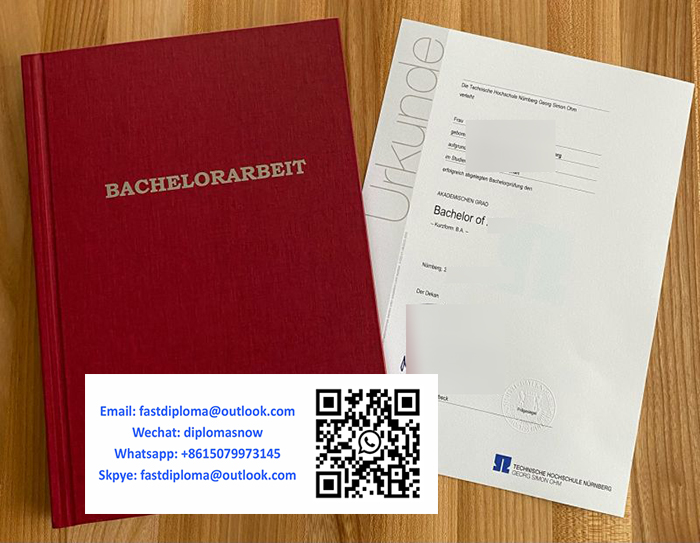
Technische Hochschule Nürnberg Urkunde
#Copy Technische Hochschule Nürnberg Urkunde. The Nuremberg University of Applied Sciences (Technische Hochschule Nürnberg Georg Simon Ohm), commonly known as TH Nürnberg, is located in Nuremberg, the second largest city in Bavaria, Germany. It is one of Germany’s largest and most prestigious public universities of applied sciences. The university is founded on a “practice-oriented” approach and is named after Georg Simon Ohm, the renowned German physicist who discovered Ohm’s Law (the law of electrical resistance). This giant of physics taught and served as rector of the university’s predecessor institution from 1833 to 1849, and his academic spirit continues to profoundly influence the institution. Technische Hochschule Nürnberg diploma sample 2026.
History and Scale: The university’s history can be traced back to the “Municipal Polytechnic School” founded in 1823 by Johannes Scharrer, the mayor of Nuremberg, one of the oldest technical schools in Europe. In 1971, under the Bavarian State University of Applied Sciences Act, the school was officially established as a modern university, and in 2013 it was renamed Technische Hochschule Nürnberg Georg Simon Ohm, highlighting its special positioning as a university of applied sciences and its research strength.
Currently, the school has approximately 13,000 students and over 300 professors, comprising 13 faculties covering more than 50 undergraduate and master’s programs in fields such as applied chemistry, architecture, civil engineering, business administration, electrical engineering, computer science, mechanical engineering, social sciences, and design. In the 2025/2026 CHE German University Rankings, the school consistently ranks among the top in key indicators such as practical orientation, laboratory facilities, and industry collaboration. Tips for Easily Obtaining a Technische Universität Berlin Urkunde.
Degree Program Overview: TH Nürnberg fully adopts the Bologna System, awarding Bachelor’s and Master’s degrees. According to the college’s structure, the main degree programs include:
Engineering Departments (Representative Programs)
Materials Engineering Bachelor’s/Master’s: One of the university’s flagship programs, boasting nearly 50 laboratories and over 150 high-end analytical instruments, covering three major materials areas: metals, plastics, and ceramics/glass. Since 2023, professors in this college have had the authority to grant doctoral degrees, and outstanding master’s graduates can directly pursue doctoral studies within the college. The curriculum emphasizes sustainability, focusing on cutting-edge topics such as biopolymer alternatives to plastics, lightweight structures, and fuel cell materials.
Mechanical Engineering Bachelor’s/Master’s: Offers dual-degree opportunities at the bachelor’s level, in collaboration with Tongji University (China) and Monterrey University of Technology (Mexico). Completing two semesters of overseas study leads to a dual degree. Master’s programs include Industrial Engineering and Management, Urban Mobility (in collaboration with the College of Civil Engineering), and Facilities Technology.
Mechatronics/Precision Engineering Bachelor’s: 3.5 years (210 ECTS), awarding a Bachelor of Engineering degree.
Electrical Engineering and Information Technology Bachelor’s: 3.5 years, awarding a Bachelor of Science degree.
Bachelor of Medical Engineering: 3.5 years, Bachelor of Engineering degree awarded.
Interdisciplinary Collaborative Programs
Master of Energy Management and Energy Technology: Jointly offered with Ansbach University of Applied Sciences and Weinsteiger-Trierdorf University of Applied Sciences, Master of Science degree awarded.
Bachelor of International Business and Technology: An interdisciplinary collaborative program between the School of Mechanical Engineering and the School of Economics, cultivating well-rounded talents with both engineering and management skills.
School of Design and Social Sciences
Bachelor of Design/Master of Design
Bachelor of Social Work/Master of Social Work
Bachelor of Communication Design
School of Economics and Computer Science
Bachelor of Business Economics/Master of Business Administration
Bachelor of International Business Management
Bachelor of Computer Science/Master of Computer Science
Application-oriented directions such as Industrial Software and Smart Logistics
Practice-oriented and Industry-collaborative: TH Nürnberg’s core philosophy is “equal emphasis on theory and practice.” Data shows that 75.7% of undergraduate theses in the School of Materials Engineering are completed in collaboration with industry, and this figure reaches 74.8% at the master’s level. The average third-party research funding per professor exceeds €60,000. The university is located in the same city as the headquarters of Siemens AG and has jointly established an Industrial Internet of Things (IIoT) laboratory with industrial giants such as KUKA Group. The Nuremberg region, where the university is situated, is one of the strongest economic regions in Germany, providing students with unparalleled opportunities for internships and employment.