

 Fake USA Degrees
 Fake CAD Degrees
 Fake AUS Degrees
 Fake UK Degrees
 Fake International Degrees

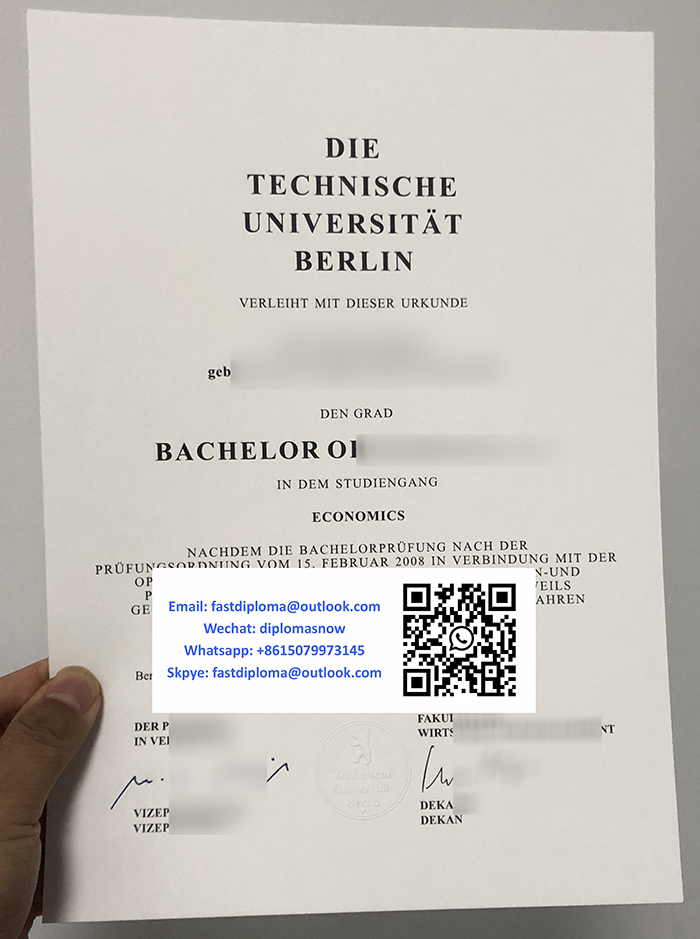
Technische Universität Berlin Urkunde
Technische Universität Berlin Urkunde 2026. The Technical University of Berlin (TU Berlin), located in Berlin, the capital of Germany, is one of Germany’s oldest and largest technical universities. As a core member of the German University Alliance (TU9), a group of nine leading German universities, it represents the pinnacle of engineering and natural sciences in Germany and Europe. #Copy Hochschule Anhalt Urkunde.
The university’s origins can be traced back to the mining school founded in 1770 by Frederick II. In 1879, the mining school, the architecture school, and the Royal Vocational School merged to form the Royal Technical University of Berlin, the predecessor of TU Berlin. In 1946, the university officially changed its name to the Technical University of Berlin and added humanities and social sciences programs, completing its transformation from an industrial college to a comprehensive technical university. Its iconic main building, built in 1884, is located in Berlin’s Charlottenburg district; this Italian Renaissance-style building is itself a cultural landmark of the city.
As the only comprehensive university of science and technology in the state of Berlin, TU Berlin is renowned worldwide for its outstanding research capabilities and international atmosphere. Currently, the university has approximately 35,000 students, nearly 20% of whom are from abroad, making it one of Germany’s most culturally diverse universities. Historically, ten Nobel laureates have studied or worked here, including renowned rocket scientist Wernher von Braun, Ernst Ruska (inventor of the electron microscope), and Konrad Zuse (pioneer of digital computing). These illustrious achievements have laid the foundation for its top-tier research tradition.
According to the 2021 QS World University Rankings for Engineering and Technology, the university ranks 60th globally and 17th in Europe. In terms of subject rankings, its architecture program consistently ranks 22nd globally, chemical engineering 41st, electrical and electronic engineering 51st, and mechanical and aerospace engineering 53rd. Furthermore, its mathematics and computer science and information systems programs are also among the world’s best, ranking 62nd and 73rd respectively.
In terms of academic development, the university comprises seven faculties and a teacher training center, covering a wide range of academic fields. The specific departments and programs offered are as follows:
**Family of Humanities and Education (Fakultät I):** Contains departments of Philosophy, Literature, History, Sociology, Education, and Languages and Communication. Programs offered include History and Culture of Science and Technology (Master’s) and Culture and Technology (Bachelor’s).
**Family of Mathematics and Natural Sciences (Fakultät II):** Contains departments of Chemistry, Mathematics, and Physics. Its mathematics program is ranked 51-75th globally by ARWU. Programs offered include Mathematics (Bachelor’s/Master’s), Physics (Bachelor’s/Master’s), Chemistry (Bachelor’s/Master’s), and Process Mathematics (Master’s).
**Family of Process Sciences (Fakultät III):** Contains departments of Bioengineering, Energy, Food Science, Process Technology, Environmental Protection, and Materials Science. Typical programs include Biotechnology (Bachelor’s/Master’s), Food Technology (Bachelor’s/Master’s), and Materials Science (Bachelor’s/Master’s).
Faculty of Electrical Engineering and Computer Science (Fakultät IV): Includes departments of Energy and Automation, High Frequency and Semiconductor, Communications, Microelectronics, Software Technology, and Economic Information. Strong programs include Electrical and Electronic Engineering (Bachelor’s/Master’s), Computer Science (Bachelor’s/Master’s), and Information Management Systems (Master’s).
Faculty of Mechanical Engineering and Transportation Systems (Fakultät V): Includes departments of Fluid Mechanics, Psychology, Land and Marine Transportation, Aerospace Engineering, Precision Machinery, and Mechanical Engineering. Offers courses in Mechanical Engineering (Bachelor’s/Master’s), Transportation Engineering (Bachelor’s/Master’s), Aerospace Engineering (Master’s), Biomedical Technology (Master’s), and Human Factors (Master’s).
Faculty of Planning, Architecture and Environment (Fakultät VI): Formed by merging the former Faculty of Architecture and the Faculty of Environment, it includes departments of Architecture, Civil Engineering, Applied Geography, Geodesy, Landscape Architecture, Ecology, Sociology, and Urban Planning. The Technical University of Berlin (TBU) offers over 20 degree programs, including Architecture (Bachelor’s/Master’s), Civil Engineering (Bachelor’s/Master’s), Urban and Regional Planning (Bachelor’s/Master’s), Environmental Planning (Master’s), and Geodesy and Geographic Information Science (Master’s).
The Faculty of Economics and Management (Fakultät VII) comprises departments of Technology Management, Business Economics, National Economics, and Economic Law. It offers programs in Economic Engineering (Bachelor’s/Master’s), Business Administration (Bachelor’s/Master’s), Innovation Management, and Entrepreneurship and Sustainability (Master’s).
The TBU’s campus covers approximately 600,000 square meters, with its main campus located in the Charlottenburg district. Its university library houses 2.6 million volumes, providing abundant academic resources for faculty and students. Benefiting from Berlin’s geographical advantage as the capital of Germany and a creative capital of Europe, the university maintains close collaborations with numerous research institutions, industrial enterprises, and cultural sectors, providing students with abundant internship and employment opportunities. Whether pursuing cutting-edge engineering technology or exploring interdisciplinary innovative research, the TBU is an ideal choice.