

 Fake USA Degrees
 Fake CAD Degrees
 Fake AUS Degrees
 Fake UK Degrees
 Fake International Degrees

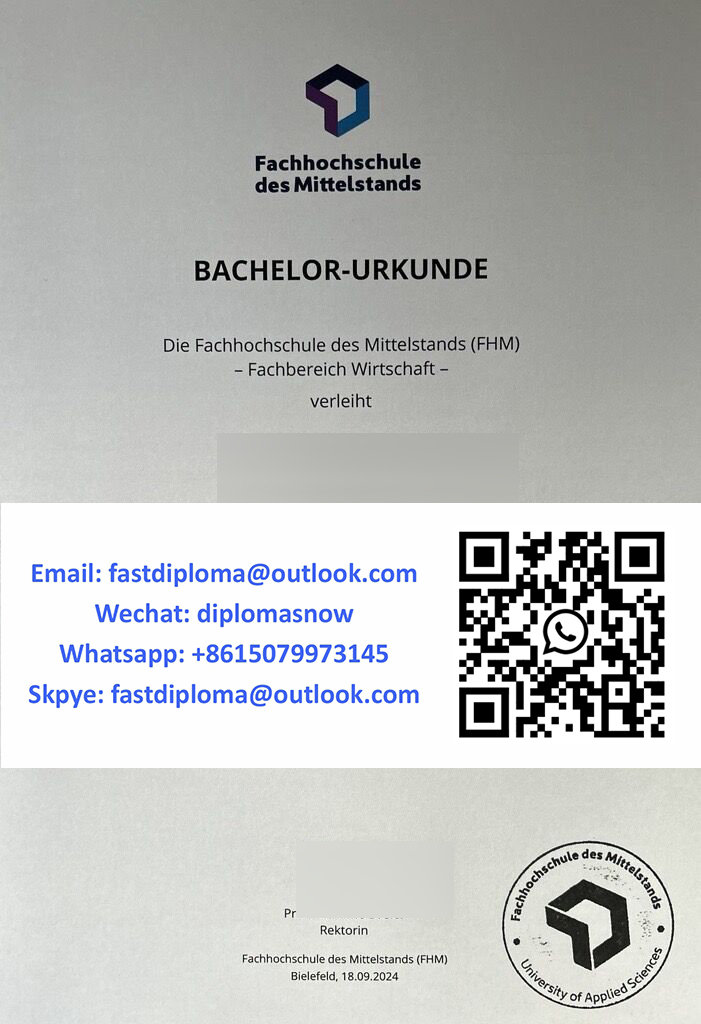
Fachhochschule des Mittelstands Urkunde
In the landscape of German higher education, one private university of applied sciences stands out with its unique positioning and mission—the German University of Applied Sciences (Fachhochschule des Mittelstands, FHM), founded in 2000. Make a Fachhochschule des Mittelstands Urkunde. As its name suggests, the university’s core philosophy revolves around “Mittelstand” (middle class/small and medium-sized enterprises), making it the only higher education institution in Germany to explicitly include “middle class” in its name and as its guiding principle.
FHM’s origins lie in the shared vision of the German craft industry. In 2000, the Paderborn Crafts Association, the East Westphalia-Lippey Crafts Association, and the West German Crafts Congress jointly established this private, state-recognized university of applied sciences in Bielefeld. Today, its main operating body is the Paderborn Education and Crafts Foundation (Stiftung Bildung & Handwerk). From its inception, the university’s DNA has been marked by its focus on craftsmanship, practical experience, and the needs of small and medium-sized enterprises. Replacement of the Hochschule Kaiserslautern Urkunde.
After more than two decades of development, FHM has grown into one of Germany’s leading private higher education institutions. Currently, approximately 5,500 to 5,800 students are enrolled at FHM throughout Germany. The university boasts nine campuses across Germany, including in Berlin, Hanover, Cologne, Bamberg near Munich, and Rostock, forming a nationwide teaching network. In addition, FHM operates the digitally-based FHM Online-University, providing flexible and convenient distance learning options for students unable to attend in-person classes.
FHM offers a broad range of courses closely aligned with market demands, covering fields such as economics, technology, media and communication, health, social education, and psychology. Its curriculum is highly application-oriented: all Bachelor’s and Master’s programs are accredited by authoritative organizations such as FIBAA or AHPGS. The university employs a unique “trimester” (three-semester) structure, with intensive instruction for the first two months of each year, followed by examinations, ensuring a fast-paced and efficient learning environment. During the teaching process, FHM emphasizes small class sizes and individual tutoring to ensure that each student receives ample attention and guidance.
As a university deeply integrated with the business community, FHM’s faculty includes not only full-time professors but also a large number of part-time lecturers from the economic sector, with 38.5% of its teaching staff being practical experts. In applied research, FHM focuses on real-world issues facing SMEs such as digital transformation, cybersecurity, and sustainable development. For example, its “KIDiHa” project, in collaboration with the Jülich Research Centre and the North Rhine-Westphalia government, specifically studies the practical application of artificial intelligence in the handicrafts sector. The university also houses the Institute for Cybersecurity and Innovation (located in Düren) and the Institute for Entrepreneurship and Succession, directly serving the technological upgrading and intergenerational succession needs of SMEs.
FHM’s educational quality has gained widespread recognition in Germany and Europe. It has received institutional accreditation from the German Science Council (Wissenschaftsrat) and has repeatedly been rated “Best Business School” by the authoritative German evaluation agency, Deutschland Test. Its graduates enjoy excellent employment prospects; statistics show that as many as 98% of FHM students successfully find employment or pursue further studies within one year of graduation. Of particular note is that 90% of the undergraduate theses at FHM are completed in collaboration with businesses, fully embodying its “learning by doing” educational philosophy.
Looking back on FHM’s development, from a small college relying on the craft industry to a mature higher education institution with thousands of students, campuses throughout the country, and an online university, FHM has always adhered to its original mission of “cultivating elites for small and medium-sized enterprises.” As the Minister of Culture and Science of North Rhine-Westphalia stated during the celebration of the school’s 25th anniversary: ”FHM is cultivating our future professionals—closely aligned with practice and meeting economic needs, which is the best prerequisite for students to successfully launch their careers.” For students hoping to obtain a solid vocational education in Germany and quickly integrate into the German business world, FHM is undoubtedly a unique path worth considering.