

 Fake USA Degrees
 Fake CAD Degrees
 Fake AUS Degrees
 Fake UK Degrees
 Fake International Degrees

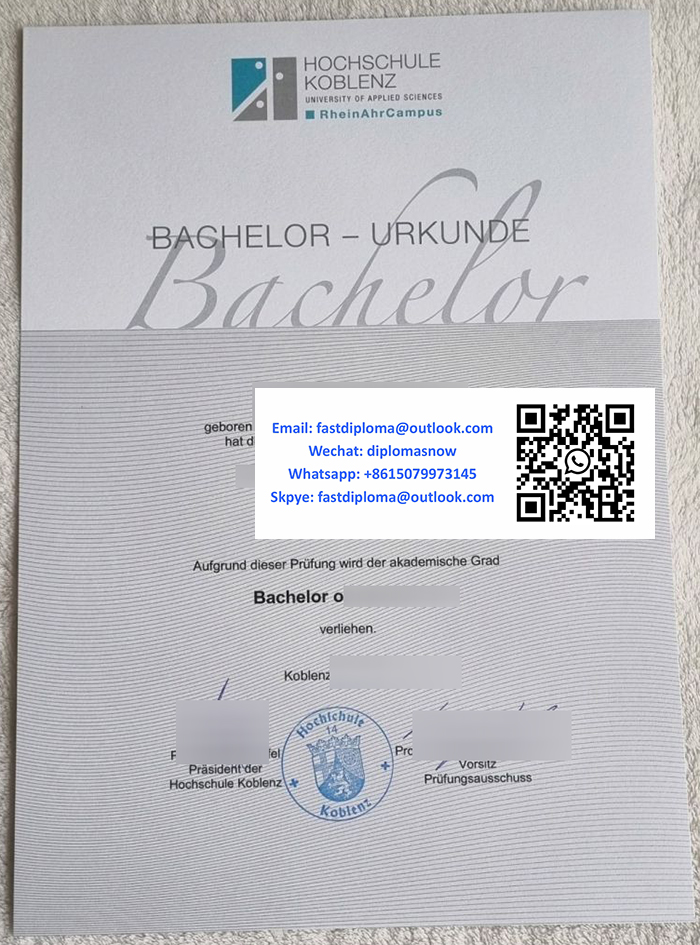
Hochschule Koblenz Urkunde
Hochschule Koblenz Urkunde sample from Germany, Located in Rhineland-Palatinate, Germany, at the confluence of the Rhine and Moselle rivers, lies the Koblenz University of Applied Sciences (Hochschule Koblenz), a higher education institution that perfectly blends rich historical heritage with modern innovation. Since its official establishment in 1996, this public university of applied sciences has grown into a comprehensive university with approximately 8,700 students, three campuses, and five faculties.
Three Campuses: Distinctive Academic Landscapes The unique feature of the Koblenz University of Applied Sciences is its distributed layout of three campuses, each with its own distinct academic focus and historical heritage.
The main campus (RheinMoselCampus) is the largest campus, with over 6,000 students. The academic distribution here clearly reflects the university’s focus on applied sciences—approximately 52% of students are in economics and social sciences, while approximately 48% are in engineering and computer science. The campus houses core departments such as Architecture-Art-Materials and Engineering, equipped with modern light simulation labs, XR technology labs (VR/AR), and digital labs, providing students with a complete practical chain from design conception to model making. Savvy ways to get a Linnaeus University degree certificate.
The RheinAhr Campus has approximately 2,500 students. This campus excels in mathematics, information technology, and technical disciplines, and is equipped with high-performance computing clusters (particularly suitable for artificial intelligence research), gait analysis labs, scanning electron microscopes, and other cutting-edge research equipment. Notably, it offers the only undergraduate program in laser technology in Germany, fully demonstrating the university’s leading position in this specialized field.
The Höhr-Grenzhausen Campus, though with only about 100 students, carries the richest history—its predecessors can be traced back to a ceramics school established in 1879. Today, it remains a leading center for glass and ceramics engineering, offering programs in art ceramics and glass design, and boasting a unique on-campus ceramics firing workshop among German universities.
Practice-Oriented: Seamless Transition from Classroom to Workplace
As a university of applied sciences, Koblenz University of Applied Sciences considers practical application the lifeblood of its education. Data shows that 79.3% of undergraduate engineering theses are completed in collaboration with industry; this figure rises to 87.3% at the master’s level. This means that the vast majority of students have already been deeply involved in real-world industry projects before graduation, accumulating valuable practical experience. Furthermore, approximately 5% of engineering courses are taught directly by industry professionals, and the freshman orientation support system boasts a high score of 14/16, ensuring students receive ample guidance at every stage from enrollment to graduation.
International Cooperation and Connections with China
Koblenz University of Applied Sciences is also a highly internationalized institution. As early as 2007, the university established a cooperative project with the Sino-German Institute of Science and Technology at Qingdao University of Science and Technology in China, conducting joint training programs in fields such as automation and mechanical engineering. English-taught courses typically require an IELTS score of 6.5 or equivalent, while German-taught courses require a TestDaF score of 16 or a DSH-2 certificate.
In conclusion, the diploma from Koblenz University of Applied Sciences embodies a young university’s unwavering pursuit of educational quality and the professional wisdom accumulated across its three historic campuses. Here, students gain not only a degree on paper, but also skills honed in modern laboratories, experience gained through close collaboration with industry, and the rigorous and pragmatic spirit characteristic of the German applied sciences education system.